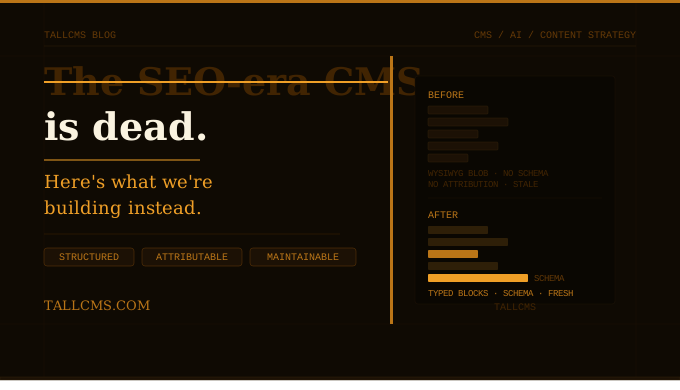
The SEO-era CMS is dead. Here’s what comes next.
The SEO-era CMS is dead. Not because search disappeared — but because content is no longer consumed the way it used to be.
We’re no longer writing just for Google.
We’re writing for systems that read, extract, and synthesise.
And most CMS platforms aren’t built for that.
Search visibility still matters. But the next advantage is making content structured, attributable, and maintainable — and that’s exactly what we’ve designed TallCMS around.
The shift: from ranking to understanding
WordPress became dominant by solving a real problem: making it easy to publish crawlable, keyword-targetable content.
Install Yoast. Fill in the meta description. Hit publish. Google does the rest.
That playbook still works — but it’s no longer sufficient.
When someone asks ChatGPT, Perplexity, or Claude a question, the result isn’t a list of links.
It’s a synthesised answer built from sources that are readable, attributable, and trustworthy.
Your content either makes it into that synthesis — or it doesn’t.
The better question isn’t “how do we optimise for AI?”
It’s:
What does it mean for content to be genuinely legible in 2025?
What “legible” actually means
AI systems don’t “rank” content the way search engines do.
They extract and reconstruct meaning.
That changes what matters:
Structured data → a machine-readable contract of what your content is
Attribution → who wrote this, and why they’re credible
Extractability → can a section stand alone as an answer?
Freshness → is this still accurate today?
These aren’t new ideas. They’re extensions of what good semantic HTML has always aimed for.
But now, they’re no longer optional.
A simple framework: SAME content
We think modern CMS platforms should optimise for:
Structured — content has clear, defined meaning
Attributable — authorship and credibility are visible
Maintainable — content stays current over time
Extractable — content can be reused and understood in parts
SAME content is what survives in AI-driven environments.
What to be careful about
Some “AI CMS” claims are moving faster than reality. Here’s the honest take:
“llms.txt is the new robots.txt”
Interesting, but not stable enough yet to build a strategy around.“AI consumes content via APIs, not browsers”
Overstated. Clean, crawlable HTML still matters.“Structured content guarantees AI citations”
No guarantees. But it does make content more extractable and more likely to survive summarisation intact.
The worst version of the “AI CMS” idea is chasing trends.
The best version focuses on what has always mattered:
clear, structured, trustworthy content.
AI legibility is a consequence — not a feature.
Content maintenance is the missing layer
Most CMS platforms are built for publishing.
Almost none are built for keeping content alive.
It’s like having 500 articles…
and no system to tell you which ones are outdated.
In the AI era, that’s not just an SEO issue — it’s a trust issue.
A well-maintained content base is far more valuable than one that published heavily and stopped updating.
A CMS should be able to say:
“This article hasn’t been reviewed in 18 months”
“These 5 pages may contain outdated information”
That’s not a “nice-to-have”.
That’s core infrastructure.
We believe making content maintenance as easy as creation is one of the most underrated problems in this space — and one of the most durable.
What we’re building
TallCMS is built on Laravel and Filament — a stack developers already trust.
Here’s how we apply this thinking in practice:
Schema-first content types
Add an FAQ block → it automatically outputs valid Schema.org markup.
No plugins. No manual JSON-LD.
First-class attribution and review metadata
Author credentials, last-reviewed dates, and expert attribution are built into the editor — not hidden in custom fields.
Maintenance workflows built-in
TallCMS flags stale content automatically:
“This article hasn’t been reviewed in 18 months”
→ and surfaces it for action.
Structured blocks by default
Content isn’t stored as WYSIWYG blobs.
It’s stored as typed, structured data — making structured output natural, not forced.
This isn’t an add-on layer.
It’s the foundation.
What we’re deliberately not building
Saying no matters.
AI content generation in the editor
Not a CMS feature. That’s a shortcut that degrades content quality over time.
Headless-only architecture
TallCMS is full-stack by default — admin, frontend, themes — with a strong API when needed.
Promising AI citeability
We can improve structure, attribution, and clarity.
We can’t control what AI systems choose to surface.
We won’t pretend otherwise.
What to look for in any CMS
If you’re evaluating CMS platforms today, look for:
Schema-first content types (not plugins)
First-class author attribution
Built-in freshness / review signals
Structured FAQ / Q&A blocks
Clean API output
Stale content detection
(Optional) llms.txt support
These aren’t trends.
They’re signals of a system built for the next phase of the web.
The bottom line
WordPress won the SEO era by making publishing easy.
The next era rewards something else:
content that is structured, attributable, and continuously maintained.
AI doesn’t change what matters.
It just exposes which systems were built well — and which weren’t.
That’s the bet behind TallCMS.
Try TallCMS
If you’re building content-driven products and care about structure, quality, and long-term maintainability:
→ Try TallCMS Core (free)
→ Or explore how we’re rethinking CMS architecture
Comments
No comments yet. Be the first to share your thoughts!