GEO: The discipline that makes your CMS choice matter more than ever
Generative Engine Optimization isn't a new SEO trick. It's a fundamental shift in what "visible content" means — and your CMS is either built for it or it isn't.
You've probably noticed the pattern by now. You search for something, and instead of ten blue links, you get a paragraph. A confident, synthesised answer pulled from sources you never clicked on, written by an AI that decided — without asking you — which content was worth citing.
That's Generative Engine Optimization territory. And most CMS platforms aren't built for it.
What GEO actually is
Generative Engine Optimization (GEO) is the practice of structuring content and building brand authority so that AI systems — ChatGPT, Google's AI Overviews, Perplexity, Claude — surface your content in their generated answers.
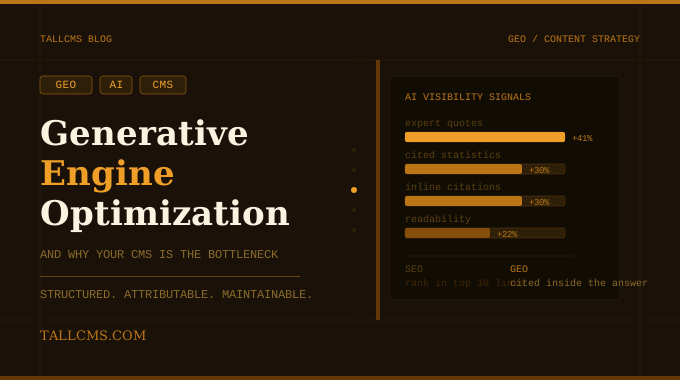
Traditional SEO gets you into the top ten results. GEO gets you cited inside the answer itself. The distinction matters because the behaviour is different: a user who gets a synthesised AI response often doesn't click through at all. Your content either shaped the answer, or it was invisible.
This isn't a niche concern. AI-generated answers are now the default experience for a growing share of queries. The question isn't whether GEO matters. It's whether your content infrastructure is ready for it.
How GEO differs from SEO
| Target | Traditional SEO | GEO |
|---|---|---|
| Goal | Rank in top 10 results | Be cited inside the AI answer |
| Signal | Backlinks, keywords, authority | Structure, clarity, attributability |
| Traffic model | Click-through to your site | Brand authority without the click |
| Content unit | The page | The paragraph |
| Optimisation target | The crawler | The language model |
The last row is the most important one. SEO optimises for a crawler that indexes pages. GEO optimises for a language model that extracts meaning from paragraphs — sometimes a single paragraph from a long article. If that paragraph isn't clear, specific, and attributable on its own, it won't survive the extraction.
The five things GEO actually requires
1. Intent over keywords
GEO rewards content that answers specific questions in natural language. Not "best CMS for SEO 2025" repeated eleven times — but a paragraph that directly and clearly answers "what should I look for in a CMS for AI visibility?" FAQs and conversational query formats perform well here because they mirror how people actually prompt AI systems.
2. Structure that LLMs can parse
Heading hierarchy matters — not for humans skimming, but for AI systems extracting. Clear H1, H2, H3 structure, bullet points for lists, tables for comparisons. An LLM reading your content should be able to identify what each section is about without ambiguity. Walls of prose with no structure are extractable only by accident.
3. E-E-A-T signals that are actually in the content
Expertise, Experience, Authoritativeness, Trustworthiness. These aren't abstract concepts — they're concrete signals: expert quotes, cited statistics, clear author attribution, last-reviewed dates. Research suggests that adding expert quotes increases AI visibility by around 40%, statistics by around 30%, and inline citations by a similar margin. These aren't decorative. They're the signals AI systems use to decide whether content is worth surfacing.
4. Semantic content chunking
This is the structural principle most content teams haven't absorbed yet. AI systems don't always cite a whole article — they extract a chunk. A definition. A specific stat. A clear comparison. Your content needs to be organised so that individual paragraphs or sections are self-contained enough to be useful in isolation. If a fact only makes sense in the context of the three paragraphs around it, it won't survive extraction.
5. Machine-readable trust signals
Who wrote this? When? What makes them credible? When was it last verified? These questions aren't just for readers — they're the metadata layer that AI systems weight when deciding what to trust. If that information lives in a plugin sidebar or isn't stored at all, it isn't doing any work.
Why your CMS is the bottleneck
Here's the uncomfortable reality: most CMS platforms make GEO harder than it needs to be.
WordPress can produce GEO-ready content — but it requires the right plugins, the right theme, disciplined editors, and constant vigilance. The architecture doesn't enforce good structure. It permits it, with effort.
Headless CMSes give developers full control over output — but they push the responsibility entirely onto the developer. Schema markup, attribution fields, freshness metadata — none of it exists by default. You build what you prioritise, and most teams don't prioritise it until it's already a problem.
The gap is a CMS that makes GEO-ready content the default output, not the result of a careful setup process.
What TallCMS is building for GEO
TallCMS is built on Laravel and Filament — a stack developers already trust. We've made specific architectural decisions that align directly with what GEO requires:
Schema-first content types. When you create an FAQ block, a how-to guide, or a product page in TallCMS, the appropriate JSON-LD structured data is generated automatically. Schema.org markup is a primitive — not a plugin you configure after the fact. An LLM reading a TallCMS page gets a machine-readable contract about what each piece of content is.
First-class attribution and review metadata. Author credentialing, publication dates, last-reviewed dates, and expert attribution are real editor fields — not custom meta buried in settings. They're there because they're E-E-A-T signals, not because an SEO checklist mentioned them.
Block-based content that chunks semantically. TallCMS stores content as typed, structured blocks — not WYSIWYG blobs. Each block is a discrete, typed unit of content. That's not just a better editing experience — it's a structural advantage for extraction. A FAQ block knows it's a FAQ. A statistic block knows it's a statistic. That metadata survives into the output.
Maintenance workflows built in. Stale content is a GEO liability. A page that hasn't been reviewed in two years is less likely to be surfaced as authoritative. TallCMS surfaces stale content proactively — not as a report you pull manually, but as part of the editorial workflow.
What we're not doing
Promising GEO results. We can make your content more structured, more attributable, and more extractable. We can't control what any AI system decides to surface. Anyone who promises specific GEO outcomes is selling something they can't deliver.
Adding AI content generation. A "write this for me" button isn't a GEO feature. Thin, AI-generated content is exactly what GEO penalises. We're building tools that improve content quality — not tools that replace the judgment required to produce it.
Chasing every emerging convention. llms.txt is interesting. We're watching it. We're not building our product story around something that hasn't stabilised.
The bottom line
GEO isn't a layer you add on top of your CMS. It's a consequence of how your content is structured, attributed, and maintained at the architectural level.
WordPress won the SEO era by making publishable content the default. The next era belongs to the CMS that makes extractable, trustworthy, well-maintained content the default.
That's what we're building TallCMS to be.
TallCMS is a Laravel/Filament-based CMS built for developers who care about content quality. Try the free Core install →
Comments
No comments yet. Be the first to share your thoughts!